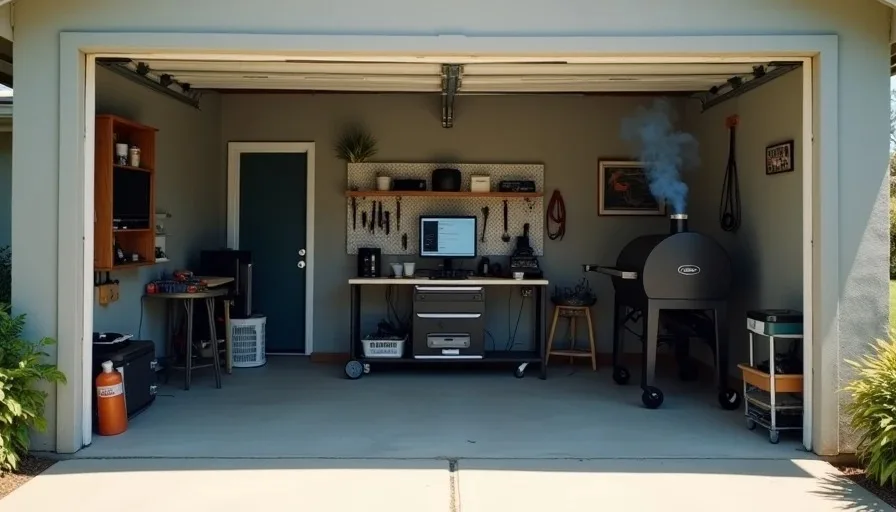
This post exists because somebody asked me why I spend twelve hours tending a brisket when I could just order one. Same reason I run Prime95 for eight hours when a fifteen-minute test would probably pass. As a Houston PC builder who works out of a garage in the suburbs, I've learned that the difference between "probably fine" and "actually fine" is measured in hours, not minutes. Last Saturday I had a client build to validate and a brisket to smoke, so I did both at the same time. Here's what happened, and why patience is the single most underrated skill in both BBQ and PC stability testing.
The Setup — 6 AM, Two Jobs to Start
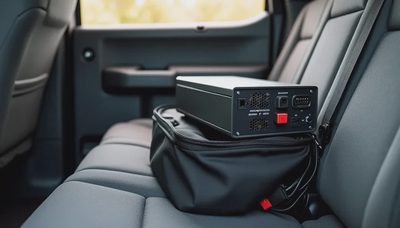
Both the smoker and the workbench need to be ready before you put anything on them. I was up at 5:45 to get the offset smoker lit and let the oak burn down to coals. By 6:15 the grate was at 250°F and holding. The brisket — a 12-pound Choice grade from H-E-B the night before — had been trimmed at midnight, coated with coarse salt and black pepper, and was sitting in the fridge uncovered to dry out the surface. At 6:30 it went on the grate fat-side down. At the same time, I set a client build on the rolling workbench: a Ryzen 5 7600X on an ASRock B650M board, 32GB of DDR5-6000, and a stock cooler the client supplied because he didn't want to spend extra on cooling. I plugged it into the Kill-A-Watt, booted it, updated the BIOS, and got Prime95 Small FFTs queued up.
The Brisket — Trimmed, Seasoned, On at 6:30
The trim matters more than people think. I take the fat cap down to about a quarter inch, remove the hard deckle fat on the underside, and square off the edges so it cooks evenly. Seasoning is just salt and pepper — 50/50 by volume, applied heavy enough that you can see it but not so thick it forms a crust before the bark sets. The meat goes on cold, straight from the fridge, because a cold surface grabs smoke better in the first hour.
The Build — A Ryzen 5 7600X Workstation Needing Validation
This was a workstation for a guy who runs QuickBooks and a couple of spreadsheets all day. He didn't need a 7600X — he needed a 7600 — but he already had the CPU from a cancelled upgrade, so we worked with it. The job was simple: assemble, update BIOS, set EXPO for the memory, and run a stability test long enough to prove the build wouldn't crash on him Monday morning. My rule is a minimum of four hours of Prime95 Small FFTs for a workstation, eight hours if it's going to a client I haven't worked with before. This was a new client. Eight hours it was.
The First Four Hours — Fire Management and Temperature Curves
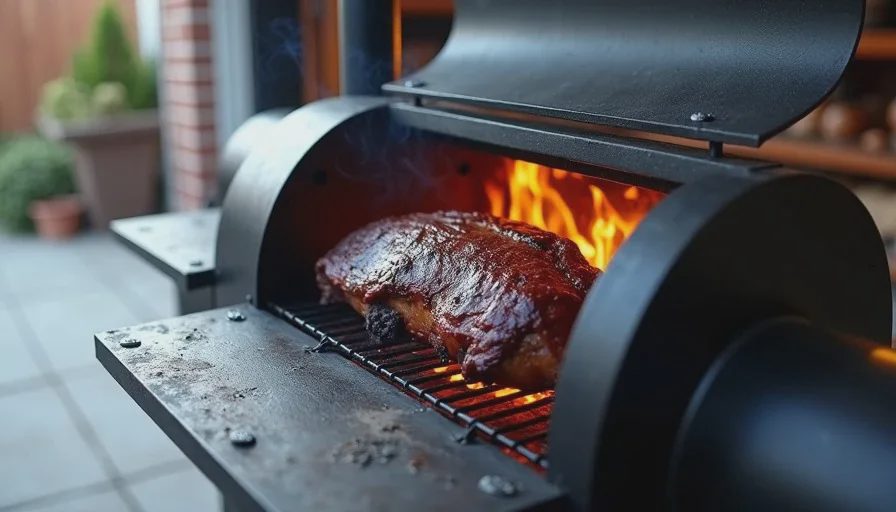
The first four hours are where both the brisket and the stability test separate the people who know what they're doing from the people who are guessing. On the smoker, the goal is holding 250-275°F with nothing but oak coals. You add a split every 45 minutes, adjust the intake damper if the temp drifts, and you don't open the lid unless you smell something wrong. On the workbench, Prime95 was pushing the 7600X to about 89°C with the stock cooler, which is high but within spec for a chip that boosts to 5.3 GHz. The power draw was holding at 88-92 watts. What I was watching for was inconsistency — spikes, drops, or workers stopping. In four hours, nothing stopped.
What Prime95 Tells You in Hour One vs Hour Four
Hour one tells you whether the build posts, whether the memory is stable at EXPO speeds, and whether the CPU cooler can handle the heat load. That's useful, but it's the easy part. Hour four tells you whether the VRMs can sustain power delivery without thermal throttling, whether the memory controller is actually stable under sustained load, and whether the PSU can hold voltage rails under continuous draw. I've seen builds that passed the first hour and failed in hour three because the motherboard VRMs overheated. That's the failure you don't want to discover at a client's desk.
Time Window | What You're Testing | Common Failure Mode |
|---|---|---|
Hour 1 | POST, memory training, cooler mount | Boot loop, EXPO instability |
Hours 1-2 | Sustained CPU load, thermal equilibrium | VRM thermal throttling |
Hours 2-4 | Memory controller under load, PSU rails | Memory errors, voltage droop |
Hours 4-8 | Long-term thermal soak, system board stress | Capacitor degradation symptoms |
The Stall — When Nothing Happens and You Wait
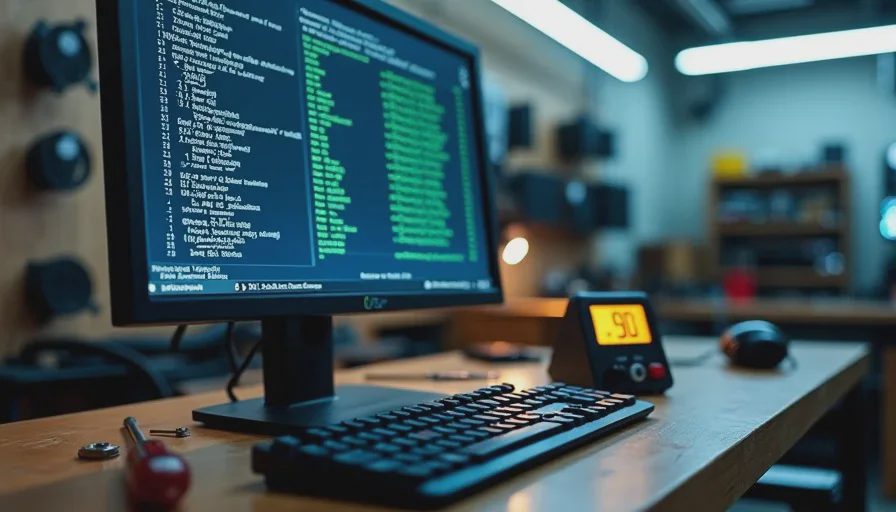
Every brisket hits a stall around 160-165°F internal, and it feels like the temperature gauge is broken. It's not. The meat is sweating, evaporating moisture, and cooling itself as fast as the heat comes in. The temperature plateaus for two hours and there is nothing you can do except wait or wrap it. I wrap in butcher paper at 170°F — not foil, because foil steams the bark soft — and push through. Prime95 hits a similar plateau. After hour three, the temperatures level off and nothing changes. Workers keep running, temps hold steady, and the temptation is to call it done. But the thermal soak hasn't happened yet. The motherboard PCB, the VRM heatsinks, the memory modules — they're still absorbing heat and will for another few hours. That's when latent failures surface.
Why Pulling Things Apart Early Ruins Both
Pull the brisket at 190°F and it's tough. Pull Prime95 at hour two and you've tested the easy part. In both cases, the work that matters happens in the back half — the part where you're bored and nothing seems to be changing. The brisket needs to hit 203°F internal and rest for at least an hour. The stability test needs to run until you're confident the system can handle eight hours of continuous load without a single error. I've had exactly one build pass four hours and fail at hour six. That was a marginal DIMM that threw a single error in the sixth hour. If I'd stopped at four, that client would have had intermittent crashes for months.
The Astros Game and the Workbench
By noon the game was on the garage TV and Cody was on his blanket in the corner with juice and crackers. The Astros were down 2-0 in the third. I checked the smoker temp, checked the Prime95 worker count, checked the score. The garage is where everything converges — the build, the brisket, the game, the kid. Jen came out around 1 PM with sandwiches and told me the brisket smelled done. I told her it had six hours left. She went back inside. The 7600X was on hour seven of Prime95, holding 87°C, no errors, no workers stopped. The offset smoker was holding 265°F with a clean thin-blue smoke. Both jobs were in the boring middle, which is exactly where you want them.
Wrapping and Finishing — The Last Two Hours
The last two hours are about consistency, not intervention. The brisket was wrapped, back on the grate, climbing from 180°F toward 203°F. I added oak splits less frequently now — just enough to hold temperature. The Prime95 run was in hour eight, and the log showed zero errors across all threads. At 4:30 PM I pulled the brisket off, wrapped it in a towel, and put it in a cooler to rest. At 4:45 I stopped Prime95 and started a Cinebench R23 run to confirm the multi-core score was in the expected range for a 7600X. It was. The build was done. The brisket rested for an hour and hit the table at 6 PM — tender, sliced clean, bark intact.
The parallel is simple. Both BBQ and a PC stability testing guide come down to the same thing: put in the time, watch the numbers, and don't shortcut the boring part. The 7600X workstation has been running at the client's office for three weeks without a crash. The brisket was gone by Sunday. I turn it on so you don't have to.